Tuesday, November 11, 2014

Fujian Tulou | China


Postcard
Tulou sites are located in the mountainous areas in southeastern Fujian, China. A tulou is usually a large, enclosed and fortified building, most commonly rectangular or circular shape, with very thick earth walls between three and five stories high and housing up to 80 families.

Smaller interior buildings are often enclosed by these huge peripheral walls which can contain halls, storehouses, wells and living areas, the whole structure resembling a small fortified city.        

Stamps
Part of a set of three stamps about Protected wildlife (issued in 2000). Three of the stamps depicts birds. (left) the Crested Ibis and (right) Red-crowned Crane. Here you see the Brown Eared Pheasant. 

Monday, November 10, 2014

Head-Smashed-In Buffalo Jump | Canada


Postcard
a? A rather strange name, but it actually makes sense when you know what’s behind that name. The buffalo jump was used for 5,500 years by the indigenous peoples of the plains to kill buffalo by driving them off the 11 metre high cliff. 

For thousands of years the native people of the plains hunted the North American bison. The plains Indian lifestyle became dependent on hunting buffalo, and they adapted numerous hunting techniques to obtain their livelihood. 

Stamps
A preprinted matching ‘stamp’ and 4 more low value definitives depicting insects. But what is the 1c USA stamp doing here? 

Emperor Qin's Terra Cotta Army | China


Postcard
In 1974 a group of farmers digging wells near Xi'an, China discovered the tomb of Emperor Qinshihuang founder of the first unified empire in Chinese history. The mausoleum dates back to 246 BCE.

The life-size terracotta solider they dug out of the ground turned out to be just one of an army of thousands, each utterly unique, with individual clothing, hair and facial features. For almost four decades, archaeologists have been excavating the site. So far, they've uncovered about 2,000 clay soldiers, but experts estimate there are more than 8,000 in total.

Sunday, November 9, 2014

Old Town Lunenburg | Canada


Postcard
Old Town Lunenburg is considered to be the best surviving example of a British colonial policy of creating new settlements by imposing a pre-designed "model town" plan on whatever tract of wilderness it was the King's pleasure to colonize.

The settlement was created in June 1753 as a home for 1,453 mostly German-speaking Protestant German, Swiss and French colonists.
Old Town Lunenburg is Unesco World Heritage site.

Stamps
A preprinted matching ‘stamp’ and a Lady Bug stamp, part of a large set of low value definitives about insects. 

Three Sisters Blue Mountains | Australia


Postcard
The Greater Blue Mountains Area is located in New South Wales, Australia, The Three Sisters is the Blue Mountains’ most spectacular landmark, attracting millions of visitors each year. The Three Sisters is essentially an unusual rock formation representing three sisters who according to Aboriginal legend were turned to stone.

Stamps
Part of a set of four stamps about Australia’s coral reefs: Ningaloo Reef and Great Barrier Reef (issued 2013). 

Saturday, November 8, 2014

Shark Bay | Australia


Postcard
Shark Bay covers an area of more than 2.2 million hectares, larger than some European nations, but has a permanent population of just under 1,000 people.

The Zuytdorp Cliffs extend for about 150 km along a rugged, spectacular and little visited segment of the Shark Bay coast. The cliffs are named after a trading ship of the Dutch East India Company, the Zuytdorp, that was wrecked against the cliffs in 1712.

Stamp
Postage prepaid on the back, but actually it is a maxi-card with matching stamp on the front. Including a first day of issue postmark.

Sydney Opera House


Postcard
The Sydney Opera House a masterpiece of 20th century architecture, one of the most distinctive buildings in the world. Designed by Danish architect Jørn Utzon, it took from 1957 to 1973 to complete it.
 
The Sydney Opera House is a UNESCO World Heritage Site since 2007.

Stamp
Year of the snake stamp 2013.

Friday, November 7, 2014

Australia week: Royal Exhibition Building and Carlton Gardens


Postcard
The grand Royal Exhibition Building was built to host the Melbourne International Exhibition in 1880–1881. It is the world's only surviving Great Hall, constructed as an exhibition space and still used for that purpose. 

A Unesco world heritage site since 2004.

Thx Steve!

Thursday, November 6, 2014

Australia week: a Fairy Penguin


Postcard
The Little or Blue Penguin, also known as Fairy Penguin, is the smallest of all penguins in the world. It is found on the coastlines of southern Australia and New Zealand.

Stamp
Part of a set of two stamps to commemorate 100 years of domestic air mail in Australia. This year will mark 100 years since French aviator Maurice Guillaux (1883-1917) made the first air mail flight in Australia. 

Thx Steve!

Wednesday, November 5, 2014

Australia week: opal mining in Coober Pedy


Postcard
Coober Pedy is an opal mining town in South Australia. Opal was first found in Coober Pedy on 1 February 1915. Since then, Coober Pedy has been supplying the world with the majority of gem quality opal.

The town is located in an extremely inhospitable environment. Half the population lives in underground dugouts to escape high temperatures in summer. Only in Coober Pedy will you find underground hotels, restaurants, bars and an underground church.

The town’s name is an anglicized version of Aboriginal words "kupa piti", meaning something like "white man in a hole".  Thx Steve!

Tuesday, November 4, 2014

Australia week: Road Trains


Postcard
Mighty roadtrains hauling livestock or merchandise of every description are a common sight along Australia’s outback highways. These huge giants of the road measure 50 metres in length, weigh 115 tonnes and can have up to 60 wheels. They travel at a top speed of 85 kilometres an hour.
Stamps
(left) The Short Beaked Echidna, an egg laying mammal, just like the Platypus. (bottom) Rottnest Island, an island off the coast of Western Australia. (right) Kookaburra, a Kingfisher Bird.  

Thx Steve!

Monday, November 3, 2014

Australia week: the Platypus


Postcard
Probably one of Australia’s most peculiar animals: the Platypus. A venomous semi-aquatic egg-laying mammal. When first discovered, the unusual look of a Platypus caused considerable confusion and doubt amongst European naturalists and scientists, many of whom believed that the animal was a fake.
 
Stamp
A prepaid postcard, with extra Platypus stamp.

Thx Steve!

Sunday, November 2, 2014

Australia week: The Outback


Postcard
The outback: Australia's desert landscapes with typical ‘red soil’.

Kata Tjuta, formerly known as The Olgas, is a group of large ancient rock formations approximately 30 kilometres away from Uluru in Australia’s Red Centre. Kata Tjuta is a sacred site in Aboriginal culture and many of the legends surrounding the site are kept secret.

Thx Steve!

Saturday, November 1, 2014

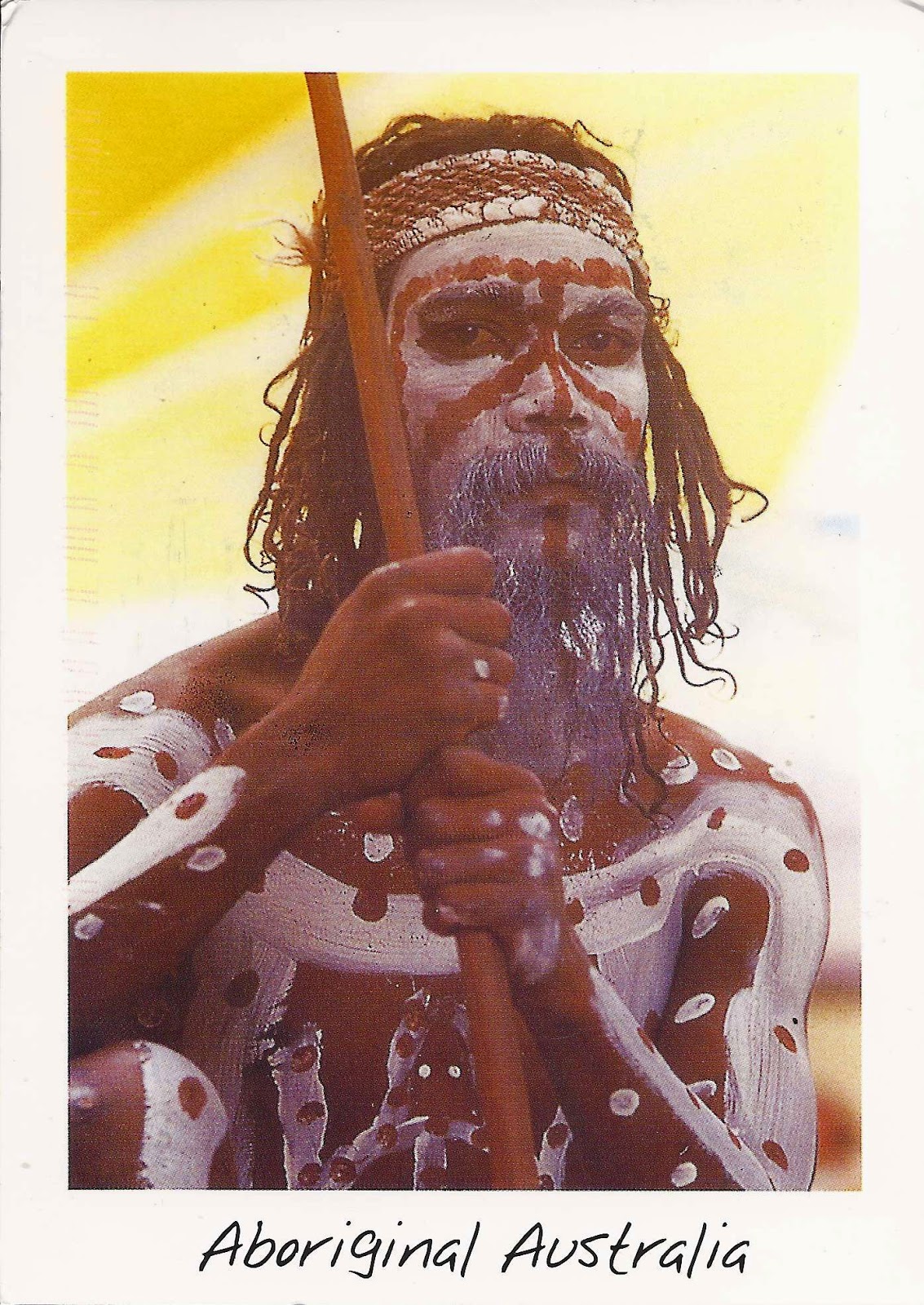
Australia week: Aboriginal Tjapukai warrior


Postcard
Aboriginal settlers arrived on the Australian continent about 50,000 years before the first Europeans began exploration in the 17th century. These Aboriginal Australians lived with a strong dependence on the land, and also the water.

Each group developed skills for the area in which they would live. The Tjapukai aboriginal tribes inhabited the rainforests of North Queensland.

Stamp
Australia Post celebrated the 88th birthday of Queen Elizabeth II with the release of one domestic base-rate (70c) stamp and one international rate ($2.60) stamp.

Thx Steve!

Flags

Free counters!

Total Pageviews