Showing posts with label Korea South. Show all posts

Tuesday, March 19, 2019

Flags of the World | South Korea


Postcard
The flag of South Korea is known by the name of Taegukgi, meaning something like “supreme ultimate flag". The flag is in use since 1882 and has a truly unique design.

The circle in the middle representing yin and yang. Surrounded by 4 black "trigrams", representing heaven, sun, moon and earth – as well as virtues including humanity, justice, intelligence and courtesy.

Sunday, September 23, 2018

Sunrise Peak on Jeju Island | South Korea


Postcard
Jeju Volcanic Island and Lava Tubes is a UNESCO World Heritage site. This site comprise three sites that make up 18,846 ha.

It includes Geomunoreum, regarded as the finest lava tube system of caves anywhere.

This postcard is about Seongsan Ilchulbong (Sunrise Peak) tuff cone, rising out of the ocean, a dramatic landscape. In the background you see Mount Halla. The highest mountain in Korea, together with its waterfalls, multi-shaped rock formations, and lake-filled crater it is the third part of this UNESCO site.

Tuesday, June 12, 2018

Hahoe Village | South Korea


Postcard
The Hahoe Folk Village is a traditional village from the Joseon Dynasty. The village is well-known for its traditional houses.

Historic Villages of Korea: Hahoe and Yangdong is a UNESCO World Heritage site. Founded in the 14th-15th centuries, Hahoe and Yangdong are seen as the two most representative historic clan villages in the Republic of Korea.

Monday, March 19, 2018

Lava Tubes on Jeju Island | South Korea


Postcard
Formed between about 100 and 300 thousand years ago, the Geomunoreum Lava Tube System comprises a series of lava tube caves formed by a flow of basaltic lava, erupted from the Geomunoreum volcano.

Jeju Volcanic Island and Lava Tubes is a UNESCO World Heritage site.

Saturday, March 10, 2018

Tumuli burial mounds of Gyeongju | South Korea


Postcard
Gyeongju is often described by the Korean tourist board as an open-air museum, thanks to its large number of grassy regal, burial mounds. Gyeongju is a major cultural site and tourist destination with about 8 to 9 million visitors annually.

Gyeongju Historic Areas is a UNESCO World Heritage site.

Monday, September 18, 2017

Jongmyo Shrine | South Korea


Postcard
Dedicated to the forefathers of the Joseon dynasty (1392–1910), the shrine has existed in its present form since the 16th century. The shrine was a primary place of worship for kings throughout Joseon Dynasty.

The memorial service, called Jongmyo Jaerye, is said to be the oldest complete ceremony in the world, and was carried out in obedience to the king’s order. Ritual ceremonies linking music, song and dance still take place there, perpetuating a tradition that goes back to the 14th century.

Tuesday, September 5, 2017

Seokguram Grotto | South Korea


Postcard
The Seokguram Grotto is an artificial grotto constructed of granite that contains a monumental statue of the Buddha. The temple was constructed between 751 and 774.

Together with Bulguksa Temple, Seokguram Grotto is a Unesco World Heritage site.

Saturday, October 11, 2014

Jeju Island


Postcard
Jejudo is a volcanic island, 130 km from the southern coast of Korea. Located on the island is Sanbangsan Mountain, the result of violent volcanic activity some 700,000 to 800,000 years ago and is in fact a huge body of lava.  

The island is a popular vacation spot for Koreans and many Japanese. It remains one of the top honeymoon destinations for Korean newlyweds. 

Stamps
The birdstamp depicts  the Black-crowned Night-Heron. Issued in 2000 as part of a set of definitive stamps. 

Thursday, September 4, 2014

Seoul, capital of South Korea


Postcard
Seoul is the capital and largest metropolis of South Korea. The Seoul Capital Area is the world's third largest metropolitan area with over 25.6 million people.

Sunday, May 4, 2014

Bulguksa Temple | 불국사 South Korea


Postcard
Bulguksa Temple, meaning "Temple of the Buddha Land" is a Buddhist temple in the North Gyeongsang province of South Korea. The temple was built in 528 during the Silla Kingdom. Once the wooden buildings completely burnt down to the ground. Although much-restored, it is still an important example of Silla architecture and is home to no less than seven Korean national treasures.

In 1995, Bulguksa was added to the UNESCO World Heritage List together with the Seokguram Grotto, which is located four kilometers to the east.

Stamps
Three more stamps from the department of tiny stamps.

Saturday, February 15, 2014

Gyeonghoeru Pavilion, South Korea


Postcard
Seoul is the capital and largest metropolis of South Korea, a megacity with over 10 million inhabitants.

Changdeokgung is one of the "Five Grand Palaces" built by the kings of the Joseon Dynasty (1392–1897). Gyeonghoeru (Pavilion of Joyous Meeting) is the oldest and most famous of Gyeongbokgung's pavilions.

It was used as a royal banquet hall during the Joseon dynasty. This two story pavilion was built in 1412, burned down by the Japanese in 1592, and reconstructed in 1867.

Stamp
A very tiny stamp.

Friday, December 14, 2012

Hwaseong Fortress from South Korea


Postcard
What is today a designated UNESCO World Heritage site was the main line of military defense for Suwon city in the late-18th century. Hwaseong Fortress is located just 30 kilometers south of the nation’s capital, and it can be said that none of South Korea's other fortresses have been preserved or restored to Hwaseong’s level.

The walls of Hwaseong Fortress run for over five kilometers and it’s full of wonderfully preserved architectural features including floodgates, observation towers, gates (even secret gates), and bastions.

Stamps
From a set of four stamps about Daejoyeong of the Balhae Kingdom (2011).

Monday, October 31, 2011

Koryo style Royal Court Dresses from Korea


Postcard
The various dynasties of Korea differed in their clothing styles. Many times the differentiation came from trying to appear more progressive than previous dynasties. Other times, the styles copied patterns from the past.

During the late Koryo period, court members made an effort to free themselves from one hundred years of influence by Yuan China.
Stamps
A spider lily, a bird named Nycticorax nycticorax (Black-crowned Night Heron) and a triangalar shaped stamp (Philately week special stamps, 2009).  

Wednesday, October 26, 2011

Jeongbang Falls | 정방폭포 , South Korea


Postcard
Jeongbang Waterfall is a famous waterfall on Jeju Island.

Jeongbang Falls is the only water fall in Asia that falls directly into the ocean. On the wall of the water fall, there is an inscription written “Seobulgwacha”, referring to Seobul passing by this place. Seobul was a servant of the Chinese Emperor Jin (BC 259~210) who was ordered by the Emperor to find the substance that would make him immortal.

Stamp
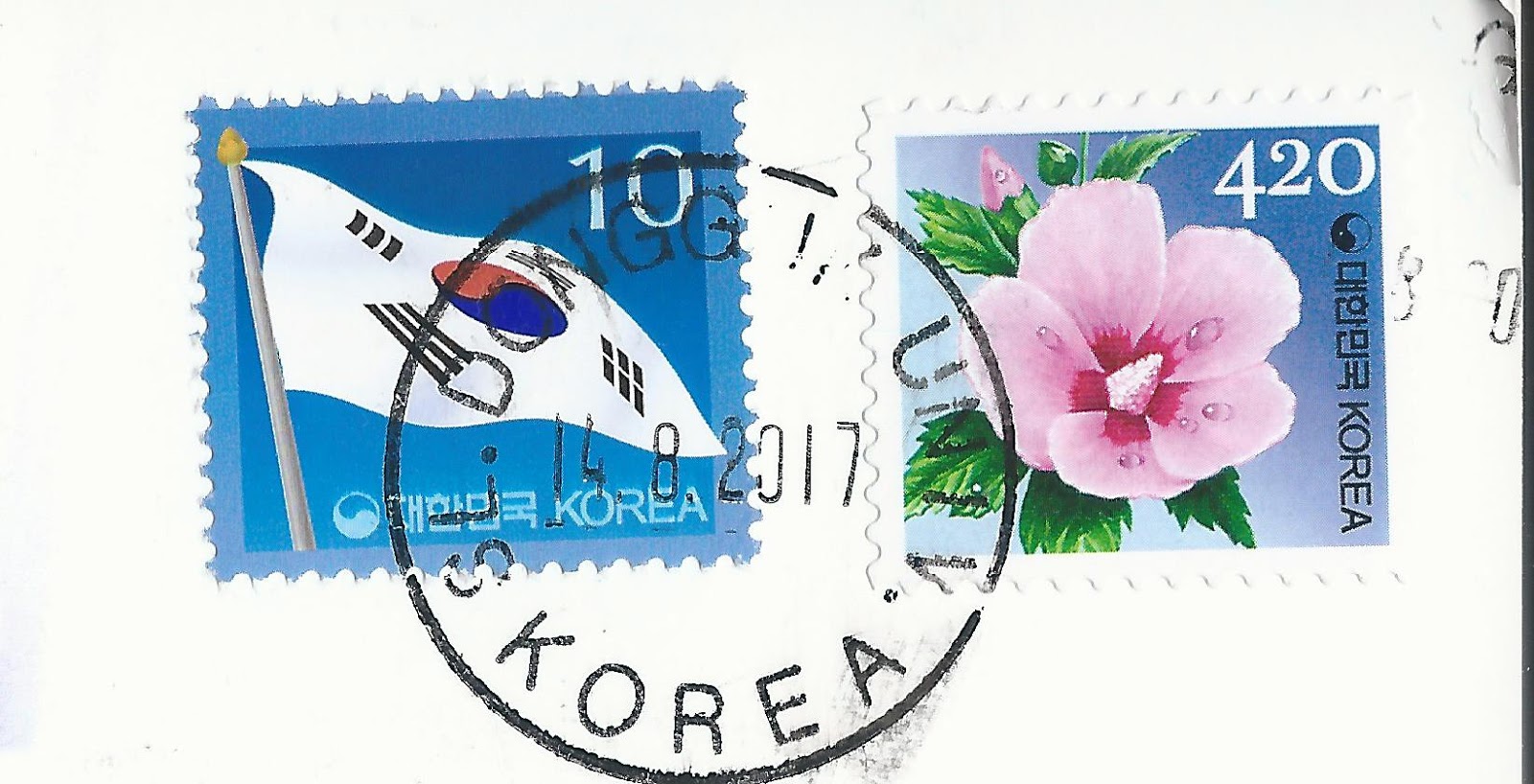
Two definitive’s, Tundra Swan and national flag.

Friday, September 2, 2011

Bulguksa Temple from South Korea

Postcard
Bulguksa (불국사, "Temple of the Buddha Land") is a Buddhist temple in the North Gyeongsang province of South Korea.


Stamp
Scelidosaurus lived during the Early Jurassic Period around 195 million years ago. Its fossils have been found in both England and in Arizona, in the United States. Scelidosaurus has been called the earliest complete dinosaur.

Flags

Free counters!

Total Pageviews